The Labor Market Returns to Delaying Pregnancy
Yana Gallen, Juanna Schrøter Joensen, Eva Rye Johansen, and Gregory F. Veramendi
With EU fertility hitting a record low of 1.34 in 2024, understanding the economic trade-offs of motherhood is crucial. Using Swedish data on contraceptive failures as a natural experiment, this paper isolates the career costs of unplanned childbirth. An unplanned first child causes a 25 percent earnings drop over six years and lasting occupational downgrades – especially for young or studying women. Delaying pregnancy by one year, however, reduces this penalty by 2.5 percentage points. As planned births cause smaller disruptions, contraceptive access and strategic birth timing remain vital for narrowing the gender pay gap.
|
|
|
|
|
Mind the Gap: AI Adoption in Europe and the US
Alexander Bick, Adam Blandin, David J. Deming, Nicola Fuchs-Schündeln, and Jonas Jessen
Special Education Substantially Improves Learning: Evidence from Three States
Stephanie Coffey, Joshua S. Goodman, Amy Ellen Schwartz, Leanna Stiefel, Marcus A. Winters, and Yunee H. Yoon
From Moderates to Extremes: How Immigration Polarizes American Politics
Johannes Matzat, Axel Dreher, Sarah Langlotz, and Christopher Parsons
Mission Possible: The Collection of High-Quality Data
Can Celebi, Christine Exley, Soren Harrs, Hannu Kivimaki, Marta Serra-Garcia, and Jeffrey Yusof
|
|
|
|
|
|
|
|
The Iran Crisis Drags Down German Business Sentiment
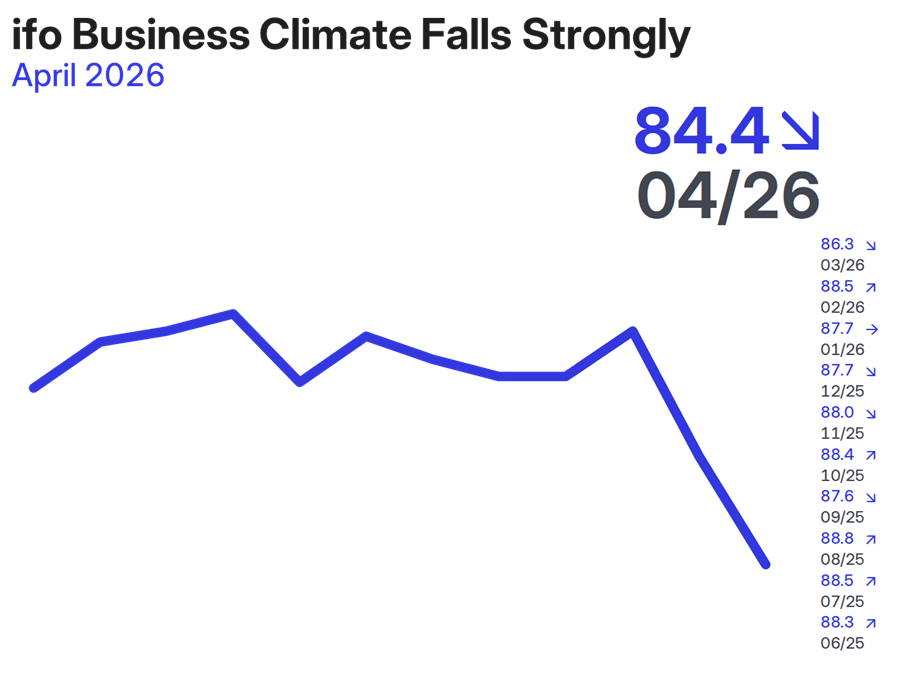
German business sentiment continues to deteriorate. The ifo Business Climate Index dropped to 84.4 in April, following a decline from 88.4 in February to 86.4 in March and hitting its lowest level since May 2020. Firms are increasingly pessimistic about their current situations and future outlooks. The German economy is heavily impacted by the Iran crisis, with gloom spanning all major sectors. In particular, manufacturing increasingly reports supply bottlenecks, logistics is under pressure, and retail fears inflation.
|
|
|
|
|
Venice Summer Institute 2026
Island of San Servolo, Venice (Italy) | 19 – 25 June 2026
The CESifo Venice Summer Institute, held annually in cooperation with Venice International University, focuses on themes of current interest in European and global economic policy. This year's program features the following workshops:
|
|
|
|
|
Big Data in the Global Economy
22 – 23 June 2026
Organizers: Feodora Teti (ifo Institute) and Andrew Bernard (Dartmouth College).
Keynote Speakers: Paola Conconi (University of Oxford) and Andreas Moxnes (BI Norwegian Business School).
|
|
|
|
|
Workforce Adjustments to Technological Change
22 – 23 June 2026
Organizers: Cäcilia vom Baur (Goethe University Frankfurt) ) and Anna M. Salomons (Tilburg University).
Keynote Speakers: David Autor (MIT) and Anders Humlum (University of Chicago).
|
|
|
|
|
The Economics of Children in a Changing World
24 – 25 June 2026
Organizers: Joachim Winter (LMU Munich) and Janet Currie (Yale University).
Keynote Speakers: Gabriella Conti (University College London) and Hannes Schwandt (Northwestern University).
|
|
|
|
|
|
“Demographic Change: Challenge and Opportunity for the Healthcare System of Tomorrow” by Heyo Krömer
20 July 2026 | 18:00 – 19:30 CET/CEST
Aging, a shortage of skilled workers, and exploding costs have a profound impact on our healthcare system – on patient requirements, staff availability, and care structures, among other things. Heyo Klaus Kroemer, Chairman of the Executive Board of Charité – Universitätsmedizin Berlin since 2019, talks about how politics and society can meet these challenges. He discusses why prevention is a crucial lever for making healthcare sustainable and fit for the future. He also sheds light on the contribution made by digitalization and artificial intelligence to be able to meet future supply requirements more efficiently.
The lecture will be held in German and livestreamed.
|
|
|
|
|
Area Conference on Global Economy
CESifo, Munich | 22 – 23 May 2026
Scientific organizer: Peter Egger (ETH Zurich).
Keynote speakers: Meredith Crowley (University of Cambridge) and Felix Tintelnot (Duke University).
|
|
|
|
|
Junior Workshop on Labor Economics
CESifo, Munich | 28 May 2026
Scientific organizers: Pia Heckl, Giuseppe Di Giacomo, Luca Perdoni (ifo Institute), and Gordon Dahl (University of California, San Diego).
|
|
|
|
|
Area Conference on Labor Economics
CESifo, Munich | 29 – 30 May 2026
Scientific organizers: Gordon Dahl (UC San Diego), Helmut Rainer (ifo Institute).
Keynote speakers: Martha Bailey (University of California, Los Angeles).
|
|
|
|
|
Area Conference on Macro with Micro Data
CESifo, Munich | 12 – 13 June 2026
Scientific organizers: Monika Piazzesi (Stanford University) and Andreas Peichl (ifo Intitute, LMU and CESifo).
Keynote speakers: Yueran Ma (University of Chicago) and Ludwig Straub (Harvard University).
|
|
|
|
|
Workshop on Digital Platforms: Methods, Policy and Politics
University of Warwick | 19 – 20 June 2026
Scientific organizers: Annali Casanueva-Artis (ifo Institute) and Mateusz Stalinski (University of Warwick).
Keynote speakers: Elliott Ash (ETH Zurich) and Ruben Enikolopov (Universitat Pompeu Fabra).
|
|
|
|
|
Junior Workshop on International Economics
CESifo, Munich | 17 – 18 July 2026
Scientific organizers: Andreas Baur, Lisandra Flach, Dorothee Hillrichs, Feodora Teti (ifo Institute), Carsten Eckel, Etienne Guigue, Martina Magli, Augusto Ospital, and Claudia Steinwender (LMU Munich).
Keynote speaker: Amit Khandelwal (Yale University).
|
|
|
|
|
|
Highlights from Past Events
|
|
|
|
|
Munich Economic Debates 2026: “Robotics for Demographic Change – Can Technology Help Ease the Burden on Younger and Older Generations in the Future?” by Alexander König
Munich | 23 March 2026
AI has taken center stage in the tech debate while other domains have faded into the background, as their developments seem less exciting – at least on the surface. Robotics may look like one of those domains. But in his lecture, Alexander König, Professor of Robotics and Assistive Systems at the Technical University of Munich, explained why, precisely thanks to the progress of large language models, robotics is also poised for takeoff.
He also showed how the widespread adoption of assistive robots at decreasing costs could revolutionize healthcare and caregiving. What is uncertain is whether Europe will be able to produce these robots on its own. To hear what he had to say on the matter, watch the full lecture.
|
|
|
|
|
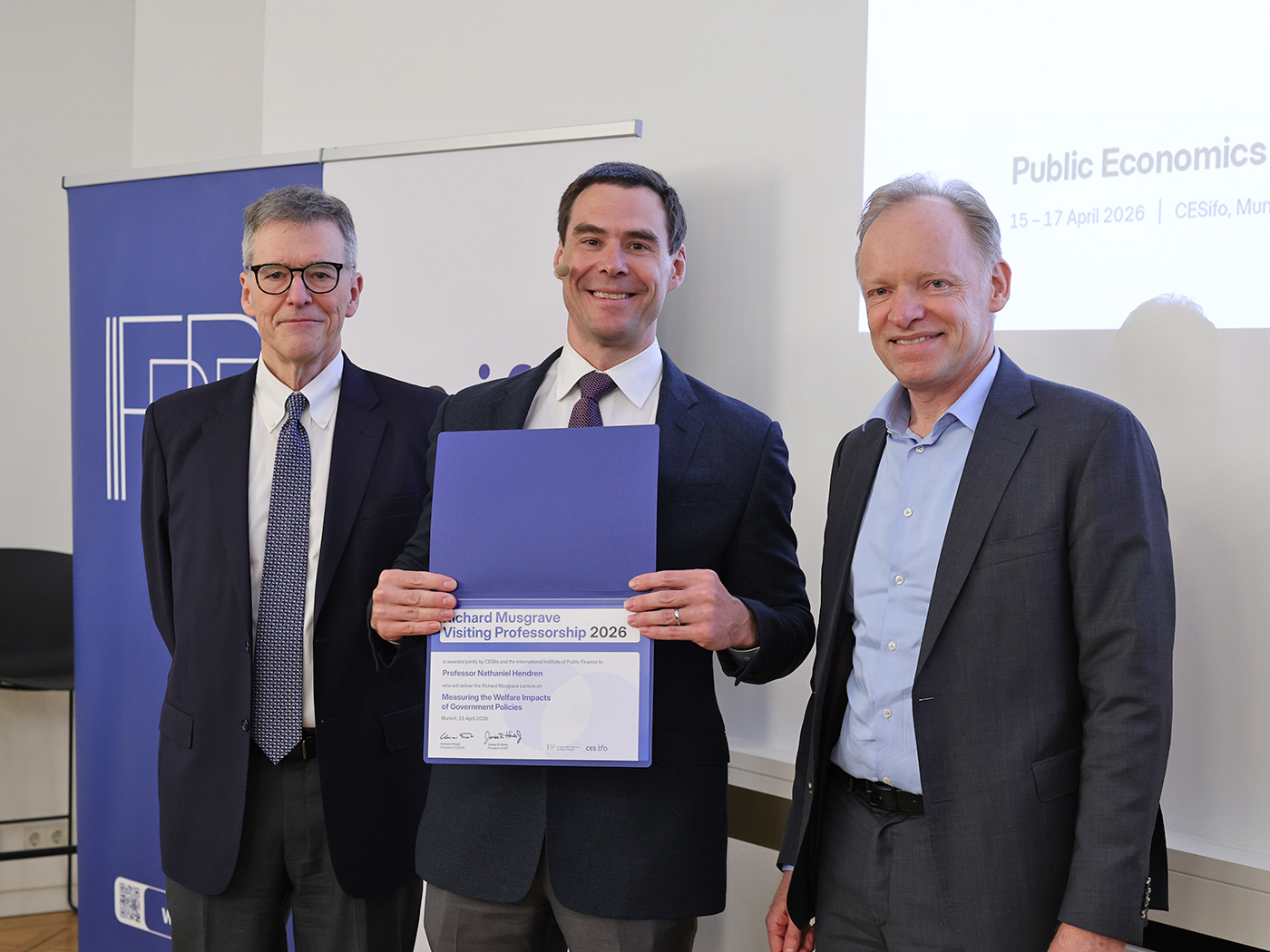
Richard Musgrave Lecture: “Measuring the Welfare Impacts of Government Policies” by Nathaniel Hendren
CESifo & International Institute of Public Finance (IIPF), Munich
15 April 2026
The primary goal when evaluating a policy is to determine if it achieved its intended objective and assess its impact. However, one must also consider the policy’s far-reaching implications. For example, a tax cut that benefits one group but indirectly harms another more severely or costs more than it benefits will ultimately have a negative impact on welfare. An even more challenging yet crucial task is to determine which policy, among different options, would most effectively improve societal well-being.
In his Richard Musgrave Lecture, Professor Nathaniel Hendren outlined a framework for doing exactly that, by harmonizing welfare measurements and enabling comparisons across different domains and policies – for example, subsidies and taxation, education, and the environment.
Watch impressions and the recording of Professor Hendren’s lecture here.
|
|
|
|
|
|
Policy Debate of the Hour
Artificial intelligence (AI) is having a profound transformative impact on the way people work, businesses operate, and economies compete globally. Against a backdrop of structural productivity decline, the new issue of EconPol Forum poses the critical question of whether Europe can harness AI as a driver of growth. How well is the continent positioned to seize the productivity benefits of AI while addressing its potentially radical implications for the labor market?
The authors address these questions by offering estimates of the expected productivity gains and breaking down the varying impacts of AI across countries, sectors, and workers. The issue examines the key drivers of AI adoption, such as beliefs, digital infrastructure, and company size, as well as its medium-term effects on economic growth and employment and its implications in terms of market competition.
Balanced regulation, workforce reskilling, and strengthening digital and innovation ecosystems are just a few of the policy priorities discussed. Read the entire magazine or individual articles by clicking the links below.
How Europe Can Capture the AI Growth Dividend
Unlocking Export Gains: The Role of AI and AI-Related Technologies
AI and Trade: Why Europe Cannot Afford to Lag on Adoption
Firms’ AI Productivity Beliefs and Adoption Decisions
The Effects of AI on Economic Growth and Employment: Results from the Economic Experts Survey
AI and Europe’s Labor Market
When AI Enters the Game: Cooperation and Predictability in Repeated Interactions
|
|
|
|
|
Robots and Non-Participation: Evidence and Lessons from the US and Europe
The fast development and spread of AI across various industries is raising growing concerns about its impact on jobs. An upcoming Policy Brief will look at how another technological wave – that of industrial robots – has affected labor force participation over the past 30 years, highlighting differences, similarities, and lessons for the present.
|
|
|
|
|
William C. Dodds, Tulane University, is visiting CES 18 May – 12 Jun 2026
Alessandra Fenizia, The George Washington University, is visiting CES 26 May – 12 Jun 2026
Nicholas Li, The George Washington University, is visiting CES 26 May – 12 Jun 2026
Gordon B. Dahl, University of California, San Diego, is visiting CESifo 27 May – 5 Jun 2026
Kristian Behrens, Université du Québec à Montréal, is visiting CESifo 1 – 5 Jun 2026
Benjamin Bushong, Michigan State University, is visiting CES 1 – 26 Jun 2026
Elizabeth U. Cascio, University of Darthmouth, is visiting CESifo 7 – 13 Jun 2026
Monika Piazzesi, Stanford University, is visiting CESifo 8 – 13 Jun 2026
Martin Schneider, Stanford University, is visiting CESifo 8 – 13 Jun 2026
Yuan Zi, Geneva Graduate Institute, is visiting CES 8 – 19 Jun 2026
Christoph Carnehl, Bocconi University, is visiting CES 15 Jun – 17 Jul 2026
Kristian Behrens, Université du Québec à Montréal, is visiting CESifo 15 – 19 Jun 2026
Menusch Khadjavi, Vrije Universiteit Amsterdam, is visiting CESifo 15 – 19 Jun 2026
Denvil R. Duncan, Indiana University, is visiting CESifo 15 – 26 Jun 2026
Myra Mohnen, University of Ottawa, is visiting CES 15 Jun – 31 Jul 2026
Deborah Cobb-Clark, University of Sydney, is visiting CES 22 Jun – 3 Jul 2026
Germain Gauthier, Università Bocconi, is visiting CESifo 22 Jun – 3 Jul 2026
Dan Fetter, Dartmouth College, is visiting CES 29 Jun – 3 Jul 2026
Heidi L. Williams, Dartmouth College, is visiting CES 29 Jun – 3 Jul 2026
Jonathan Moreno-Medina, University of Texas, San Antonio, is visiting CESifo 29 Jun – 4 Jul 2026
Viviana Rodriguez, University of Texas, San Antonio, is visiting CESifo 29 Jun – 4 Jul 2026
Albert Jan Hummel, University of Amsterdam, is visiting CES 29 Jun – 10 Jul 2026
Olivia Bordeu, University of California, Berkeley, is visiting CESifo 6 – 11 Jul 2026
Maximilian Auffhammer, University of California, Berkeley, is visiting CESifo 6 – 12 Jul 2026
Michèle Belot, Cornell University, is visiting CESifo 13 – 18 Jul 2026
Ulrich Müller, Princeton University, is visiting CES 6 Jul - 18 Dec 2026
Andreas G. B. Ziegler, VU Amsterdam, is visiting CES 9 - 24 Jul 2026
Stefano Della Vigna, University of California, Berkeley, is visiting CES 13 - 31 Jul 2026
Ulrike Malmendier, University of California, Berkeley, is visiting CES 13 - 31 Jul 2026
|
|
|
|
|
|
The Bulletin Board is where CESifo network members can post news and messages regarding conferences, workshops and journals that are of interest to the research community and to all CESifo Newsletter readers. If you have anything you would like to share, please feel free to contact us at services@cesifo.de.
|
|
|
|
|
Privacy Policy and Data Protection
We place great importance on your privacy and would like to inform you of our privacy policy. We treat your information confidentially in accordance with the General Data Protection Regulation (GDPR).
In order to provide you with more transparent and clear information on how we process your personal information, we have divided our privacy policy into various chapters. In this description you will find information on the basis on which the data is stored and how we use the data. You can also find out more about your rights, such as how to access your information and how to restrict the use of your information. Our privacy policy can be found on our website.
Subscribe | Unsubscribe | Feedback | Imprint | Privacy Policy
|
|
|
Provider
CESifo GmbH
Poschingerstr. 5
81679 Munich, Germany
Registered with the Munich District Court (Amtsgericht München) under HRB 125257
Managing Director
Prof. Dr. Dr. h.c. Clemens Fuest
VAT ID: DE218182755
Editor
Andrea Balestracci
The reprint of excerpts from this newsletter is permitted only with written permission and provided that the source is acknowledged.
© 2026 CESifo GmbH
|
|
|
|
|
|