Social Anxiety and Evaluative Interviews
Samantha Horn, Peter Schwardmann, and Egon Tripodi
Social anxiety – the fear of being scrutinized and evaluated by others – is increasingly common. At the same time, social evaluation is becoming more and more critical to gaining access to career opportunities. Using an innovative experimental design, this working paper shows how social anxiety discourages people from engaging precisely in the evaluative contexts that determine upward economic mobility, such as interviews. This finding has relevant policy implications: Accounting for mental health alongside demographic characteristics in diagnosing and addressing labor-market inequalities may improve targeting and avoid leaving affected workers behind.
|
|
|
|
|
|
Further Development in the CESifo Working Paper Series
|
|
|
|
|
|
CESifo now assigns its own DOIs to publications, supported by rich machine-readable metadata, including full abstracts. This improves long-term discoverability, reliable citation and automated indexing, and makes the papers easier to import into reference managers (such as Zotero, Mendeley and EndNote). Explore the new DOI metadata and let us know about your experience.
|
|
|
|
|
|
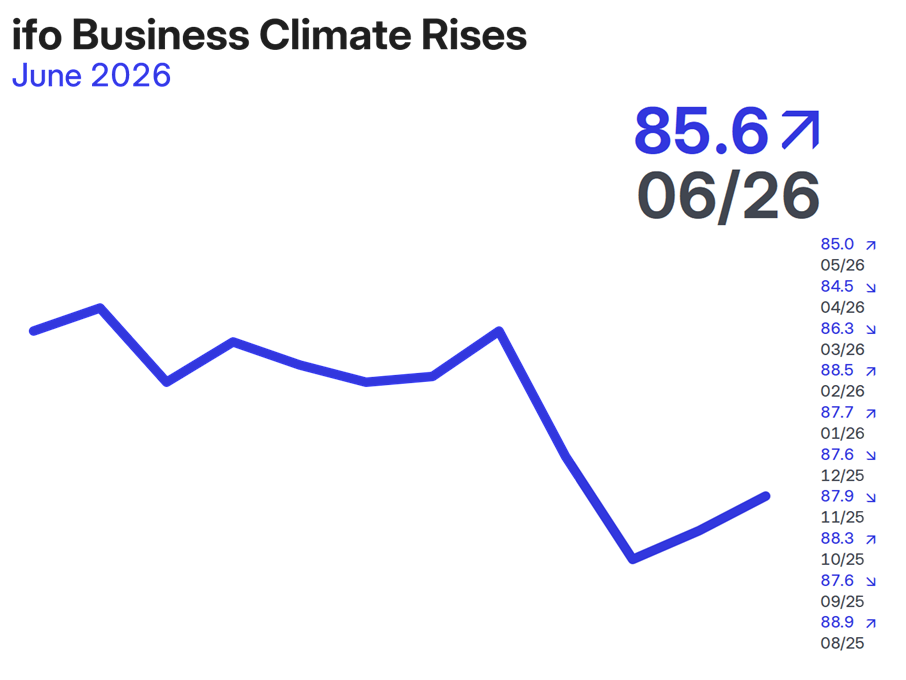
Business Climate Rebounds in May and June
After slumping in March and April, the ifo Business Climate Index has seen a partial recovery, rising for two consecutive months. The index rose to 85.6 points in June, up from 85.0 points in May. German firms are hopeful that geopolitical tensions will decline. Sentiment improved across all sectors. Expectations increased considerably in manufacturing and trade, while assessments of the current business situation improved markedly in services. Construction saw a more modest increase due to a lack of orders.
|
|
|
|
|
Munich Economic Debates 2026: “Innovation for the Next Generation” by Rafael Laguna de la Vera
Chamber of Industry and Commerce for Munich and Upper Bavaria, Munich
21 September 2026 | 18:00 – 19:30 CET/CEST
Germany urgently needs breakthrough innovations – and innovators. These could help address the challenges of demographic change while strengthening Germany’s long-term competitiveness.
Rafael Laguna de la Vera, Director of the Federal Agency for Disruptive Innovation (SPRIND), will explain why Germany needs bold innovators to usher in a new era of entrepreneurship. What sets them apart, and how can they be identified and supported? He will also discuss why research-driven entrepreneurs should be encouraged to invest in breakthrough innovations. Achieving this will require greater access to capital, pragmatic approaches to intellectual property, and attractive exit opportunities.
The lecture will be held in German and livestreamed.
|
|
|
|
|
Area Conference on Economics of Education
CESifo, Munich | 11 – 12 September 2026
Scientific organizers: Eric A. Hanushek (Stanford University) and Ludger Woessmann (ifo Institute).
Keynote speaker: John A. List (University of Chicago).
|
|
|
|
|
Area Conference on Behavioral Economics
CESifo, Munich | 23 – 24 October 2026
Scientific organizers: Ernst Fehr (University of Zurich) and Klaus Schmidt (LMU Munich).
Keynote speakers: Supreet Kaur (UC Berkley) and Philipp Strack (Yale).
|
|
|
|
|
CESifo-CEMIR Junior Workshop on Migration Research
CESifo, Munich | 28 – 29 October 2026
Scientific committee: Joop Adema, Lasha Chargaziia, Yvonne Giesing, Panu Poutvaara, Tuuli Tähtinen (ifo Institute).
Keynote speaker: Anna Piil Damm (Aarhus University).
|
|
|
|
|
|
Highlights from Past Events
|
|
|
|
|
|
“Europe’s Fiscal Squeeze: Tackling Rising Spending Pressures” by Helge Berger and Andrew Edward Hodge
13 July 2026
Europe is facing rising fiscal pressures due to aging populations, higher defense spending, and the costs of the energy transition. Without decisive action, the public debt of many EU member states will become unsustainable. Helge Berger and Andrew Hodge, respectively Deputy Director and Deputy Division Chief in the IMF’s European Department, pointed to a range of solutions to reverse Europe’s growing “fiscal squeeze.” Growth-enhancing reforms, particularly those aimed at deepening the EU single market, will be critical. At the same time, spending must be reprioritized and made more efficient, and taxation should be refocused to increase revenues while still protecting more vulnerable citizens.
Video recordings of the lecture are available on our website.
|
|
|
|
|
|
“Demographic Change: Challenge and Opportunity for the Healthcare System of Tomorrow” by Heyo Krömer
20 July 2026
An aging population is not only putting a strain on public finances, but also on healthcare systems, as the demand for medical and nursing care is growing amid rising costs and staff shortages. The impact of demographic change on the healthcare system was the focus of our latest MED lecture, delivered by Heyo K. Kroemer, Chairman of the Executive Board of Charité – Universitätsmedizin Berlin. Professor Kroemer discussed the role of prevention in improving health outcomes while reducing pressure on the system and explored how digitalization and artificial intelligence can improve processes.
|
|
|
|
|
|
Save the Date! EconPol Annual Conference: Demographics, Technology, and the Future of Work in Europe
Representation of the Free State of Bavaria to the EU, Brussels | 9 November 2026
Could the solution to Europe’s workforce challenges lie in the very forces that are transforming it? EconPol Europe’s Annual Conference will bring together leading experts, policymakers, and business leaders to examine how demographic and technological change can be harnessed to create a more productive, resilient, and inclusive labor market. From unlocking the potential of women and older workers to embracing new technologies, we will explore how Europe can turn disruption into a competitive advantage.
Join the event on 9 November 2026 in Brussels for this timely discussion on the future of Europe’s workforce. Registration will open shortly. For more details, program updates and speaker announcements, please visit the conference website.
|
|
|
|
|
EconPol Forum 03/2026: “Dealing with Demographics – The Policy Challenges of an Aging Europe”
The next edition of EconPol Forum, due out on 30 July, will take a deep dive into Europe’s aging challenge, including some of its less obvious dimensions. Beyond the pressures on Europe’s shrinking labor markets, pension systems, and social services, the issue will explore how aging affects electoral behavior and attitudes toward war and peace. Authors will also examine the broader implications of raising retirement ages on care work and gender equality – from the impact of longer working lives on grandparental childcare to the disproportionate costs of elderly care for women.
|
|
|
|
|
Robots and Non-Participation: Evidence and Lessons from the US and Europe
When automation comes, concerns about rising unemployment grow. Less attention is paid to non-participants: displaced workers who do not actively seek new employment. By examining the impact of the adoption of industrial robots in the United States between 1993 and 2014, the authors of this Policy Brief found that each additional robot led to four workers exiting the labor market. These findings highlight the importance of upskilling, labor market flexibility, and access to health and social services in (present) times of automation and an already shrinking labor force.
|
|
|
|
|
Energy Crisis Relief as Implicit Insurance: Fossil Import Dependence and Policy Design
On average, the EU relies on imports of natural gas and oil for 57 percent of its energy, leaving the continent vulnerable to external supply shocks – including the ongoing conflict in Iran. Although intended to provide economic relief, measures such as fossil fuel tax cuts weaken incentives to switch to green energy and effectively subsidize fossil fuels. By acting as implicit insurance against fuel price risks, these measures lock in Europe’s dependence. Policy adjustments are both necessary and possible.
|
|
|
|
|
Evidence Under Scrutiny: How Reliable Is the Research Backing Public Policy?
Policymakers rely on scientific evidence to inform decisions – or so one would hope. But is the underlying research always sound? This article summarizes findings from a major verification exercise conducted on 110 papers from leading journals. Although replicability has increased significantly since 2014, one in four results is not robust, and coding errors are common and often go undetected. Mandatory data-sharing policies and data editors – which have played a key role in increasing replicability – must be expanded and strengthened.
|
|
|
|
|
Andreas G. B. Ziegler, VU Amsterdam, is visiting CES 9 – 24 Jul 2026
Stefano Della Vigna, University of California, Berkeley, is visiting CES 12 – 31 Jul 2026
Ulrike Malmendier, University of California, Berkeley, is visiting CES 12 – 31 Jul 2026
Eliana La Ferrara, Harvard Kennedy School, is visiting CES 27 – 31 Jul 2026
Abu S. Shonchoy, Florida International University (FIU), is visiting CES 3 – 28 Aug 2026
Joris Mueller, National University of Singapore, is visiting CES 3 Aug – 30 Sep 2026
Florian Unger, Leuphana University Lüneburg, is visiting CESifo 10 – 14 Aug 2026
Giuseppe Moscelli, University of Surrey, is visiting CESifo 7 – 11 Sep 2026
Eric A. Hanushek, Stanford University - Hoover Institution, is visiting CESifo 7 – 13 Sep 2026
Christina Fong, Carnegie Mellon, Pittsburgh, is visiting CES 7 – 14 Sep 2026
|
|
|
|
|
|
The Bulletin Board is where CESifo network members can post news and messages regarding conferences, workshops and journals that are of interest to the research community and to all CESifo Newsletter readers. If you have anything you would like to share, please feel free to contact us at services@cesifo.de.
|
|
|
|
|
Privacy Policy and Data Protection
We place great importance on your privacy and would like to inform you of our privacy policy. We treat your information confidentially in accordance with the General Data Protection Regulation (GDPR).
In order to provide you with more transparent and clear information on how we process your personal information, we have divided our privacy policy into various chapters. In this description you will find information on the basis on which the data is stored and how we use the data. You can also find out more about your rights, such as how to access your information and how to restrict the use of your information. Our privacy policy can be found on our website.
Subscribe | Unsubscribe | Feedback | Imprint | Privacy Policy
|
|
|
Provider
CESifo GmbH
Poschingerstr. 5
81679 Munich, Germany
Registered with the Munich District Court (Amtsgericht München) under HRB 125257
Managing Director
Prof. Dr. Dr. h.c. Clemens Fuest
VAT ID: DE218182755
Editor
Andrea Balestracci
The reprint of excerpts from this newsletter is permitted only with written permission and provided that the source is acknowledged.
© 2026 CESifo GmbH
|
|
|
|
|
|